

The Customer Lifecycle Framework at Databox
Why we built a shared operating system for understanding customer behavior, aligning teams, and creating better outcomes across the lifecycle.

Most companies say they are customer-centric.
Far fewer can explain how that shows up in their day-to-day decisions.
At Databox, we have learned that customer centricity is not a principle you put on a slide. It is an operating discipline. It requires shared definitions, clear ownership, consistent signals, and a system that helps teams act on behalf of the customer in a coordinated way.
That is why we built our Customer Lifecycle Framework, or CLF.
The CLF is not a marketing model. It is not a CRM view. It is not a static journey map that gets created once and then forgotten.
It is how we operationalize our understanding of customers across the business.
It gives every team a shared view of where a customer is, what they need next, what signals matter, and where intervention can create the most leverage. It helps us move from fragmented handoffs and isolated tactics to a more consistent system for acquiring, activating, retaining, and re-engaging customers.
In a product-led company, that matters a lot.
Because growth does not come from product quality alone. It comes from how well the entire company understands user behavior and responds to it at the right moment, with the right action, in the right context.
This post is a look inside that system. Not as a polished story, but as a practical view of how we think about lifecycle management at Databox and why I believe every serious product organization should have a framework like this.
Why product-led growth needs a lifecycle framework
In reality, product-led growth only works when the organization builds around the product in a disciplined way.
The product can drive discovery, activation, habit formation, retention, and expansion. But that only happens consistently when teams share the same understanding of user behavior and know how to respond at each stage of the lifecycle.
Without that, even strong products lose momentum.
Users sign up but never activate. Customers convert but fail to build a habit. Accounts go dormant without intervention. Teams run disconnected plays based on local goals instead of lifecycle context.
That is exactly what a lifecycle framework is meant to solve.
The best product-led companies do not just build features. They build systems that help the company answer a few critical questions with consistency:
Where is this customer in their journey?
What are they trying to achieve right now?
What signals tell us they are progressing, stuck, at risk, or ready to expand?
Which team should act, and how?
That was our intent with the CLF.
We wanted a framework that creates a shared model of the customer lifecycle, defines the right strategies at each phase, and helps every team understand where they can create leverage.
That is when lifecycle thinking stops being theory and starts becoming an operating system.
The three layers of the framework
For the CLF to be useful, it has to reflect reality.
It cannot be abstract or overly academic. It needs to map to how customers actually behave, where value is created, and where the business needs visibility and intervention.
Our framework has three layers.
1. Customer Journey Phases
These are the broad phases customers move through in their relationship with Databox. They help us understand what kind of experience a user needs at a given point in time.
2. Lifecycle Strategies
These define how we approach each phase. They guide how we invest resources, what outcomes we optimize for, and what kind of engagement is most appropriate.
3. Customer Stages
These are the operational segments we use to classify users and customers based on behavior, product usage, and account status. This is where the framework becomes actionable. Teams use these stages to tailor communication, outreach, product experiences, and support.
We also use scoring to improve prioritization.
For users early in the lifecycle, we use a Product Qualified Lead score to understand activation and purchase readiness.
For paying customers, we use a Customer Score to understand adoption depth, health, retention potential, and expansion opportunities.
These signals help us allocate attention more intelligently. Not every account needs the same motion. Not every intervention should be manual. Not every low-usage account deserves the same level of investment. Good lifecycle management depends on knowing the difference.
The customer journey: three phases

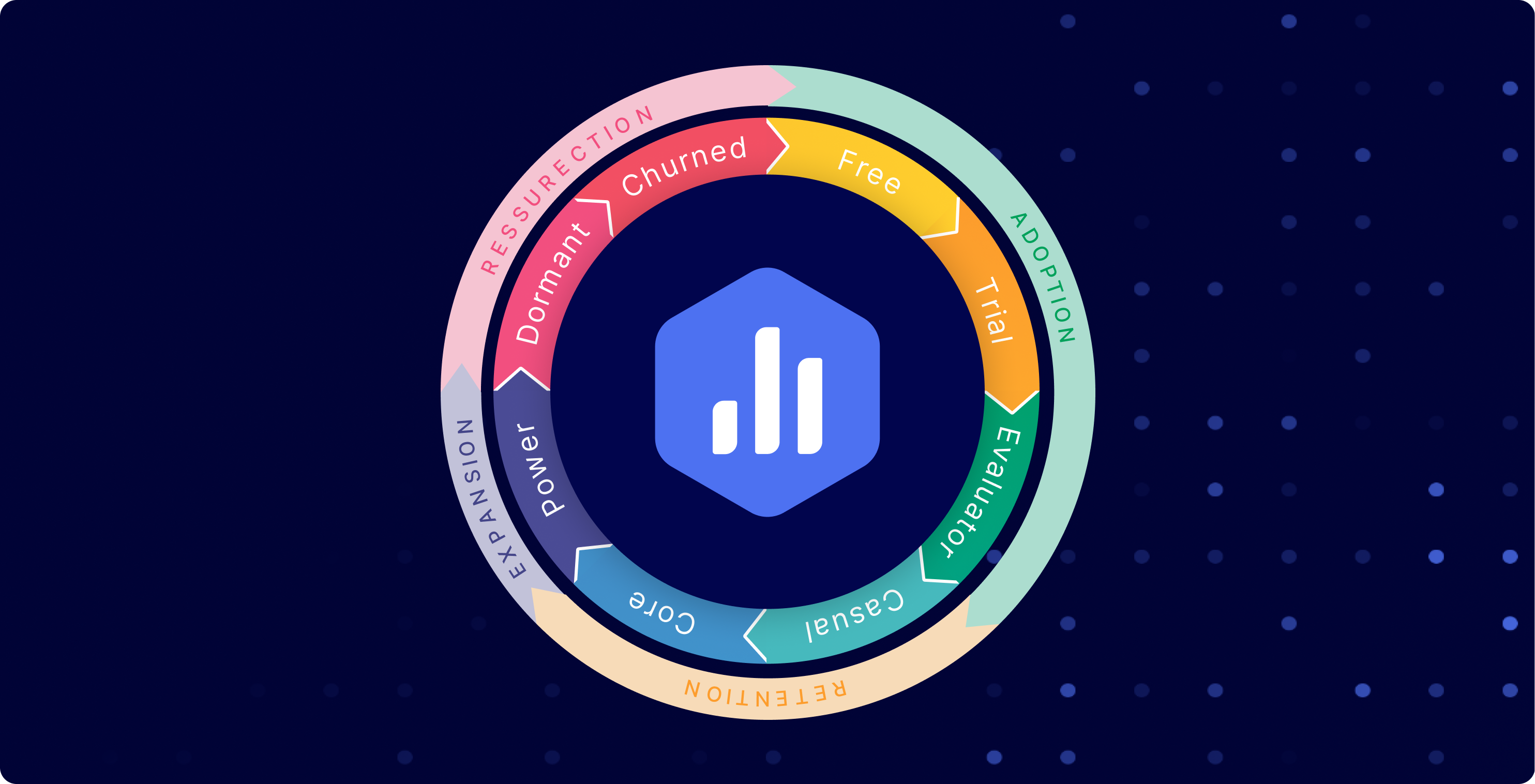
We organize the lifecycle into three core phases: Setup, Usage, and Resurrection.
Phase 1: Setup
This is where the relationship starts.
When users first join Databox, our goal is to help them get set up quickly, experience value early, and build enough momentum to keep going. This phase includes users in the New, Trial, and Active Free stages.
The primary goal here is activation.
We want users to reach their first real moment of value as quickly as possible. That means helping them connect data, understand the product, experience useful outcomes, and see what Databox can unlock for them.
This is where onboarding quality matters most. It is also where many product-led companies either build momentum or lose the customer before the relationship has really started.
At Databox, we support this phase through onboarding flows, feature activation sequences, setup offers, behavioral nudges, and targeted education. The aim is to improve Activation Score, increase the likelihood of becoming a Product Qualified Lead, and create a stronger path to paid conversion.
Phase 2: Usage
Once a customer activates and converts, the challenge changes.
The question is no longer whether they can get started. The question is whether Databox becomes part of how they work.
Usage is the phase where habits are built, workflows deepen, and customer value compounds over time. It is where we focus on sustained engagement, broader feature adoption, and stronger customer outcomes.
This phase is especially important because initial conversion can be misleading. A customer paying for the product is not the same as a customer fully adopting it. Many retention problems are simply delayed activation or shallow usage in disguise.
That is why we treat this phase as a strategic operating zone, not as a passive middle state.
We use lifecycle campaigns, onboarding support, account engagement, education, and customer scoring to understand where accounts are healthy, where more value can be unlocked, and where intervention is needed before risk turns into churn.
Phase 3: Resurrection
Not every customer continues forward in a straight line.
Some lose momentum. Some go dormant. Some churn before they ever build a durable habit. Others leave for reasons that can be addressed later with the right message, product improvement, or timing.
The Resurrection phase exists to manage that reality intentionally.
For at-risk customers, the goal is prevention. We want to identify the cause of decline early and respond before churn happens.
For churned or inactive users, the goal is re-engagement, but with clear prioritization. Some users have a strong resurrection signal. Others do not. Treating them the same is inefficient.
This phase matters, but it should not become the center of gravity. A healthy lifecycle strategy creates most of its leverage earlier through better setup, stronger activation, and deeper usage.
Our four lifecycle strategies

To make the framework operational, we defined four lifecycle strategies.
Activation and Adoption
This strategy focuses on new sign-ups, active free users, trial users, and newly acquired customers.
The goal is to help users get started well, explore the product meaningfully, and understand enough value to continue engaging. We support this through onboarding experiences, feature activation campaigns, setup guidance, and educational content.
Retention
Retention focuses on paying customers who are past the earliest stage of onboarding and have begun to establish a usage pattern.
These customers already represent real value. The priority is to preserve and deepen that value. We focus on engagement, feature adoption, account health, and preventing regression into lower-usage states.
Expansion
Expansion focuses on our highest-potential and highest-value customers, especially those in the Power stage.
These are customers who are already getting meaningful value from Databox. The opportunity here is not just commercial. It is strategic. We want to help them expand usage, unlock more sophisticated workflows, involve more stakeholders, and deepen their reliance on the platform.
Resurrection
This strategy focuses on customers who have canceled, become dormant, or stopped engaging.
Our approach depends on the reason. We use win-back campaigns, targeted outreach, and messaging tied to missed value, new features, or improved fit. But this work is deliberately more selective than the motions we apply to healthy, active customers.
Customer stages: from sign-up to churn

We classify customers into specific stages so teams can personalize their actions and prioritize the right interventions.
1. New
Free accounts created in the last 14 days.
The goal is to build early momentum, demonstrate value, and move users toward Trial.
2. Active Free
Free accounts older than 14 days with at least one activity in the last 28 days.
The goal is to maintain engagement and demonstrate the value of paid plans.
3. Trial
Accounts currently in an active trial period.
During the 14-day trial, users have access to the full product. The goal is to maximize activation, drive meaningful usage, and convert to paid.
4. Evaluator
Paid accounts that converted within the last 3 months.
This is one of the most critical stages in the lifecycle. Early churn risk is high, habits are still fragile, and perceived value is still forming. The goal is to build product usage and move customers toward Core or Power.
5. Casual
Paid accounts older than 3 months with occasional activity and low feature adoption.
This segment often represents under-realized potential. The goal is to increase engagement and help customers discover broader value in the product.
6. Core
Paid accounts older than 3 months with regular usage and moderate feature adoption.
These are healthy customers with room to deepen value. The goal is to retain them and move more of them toward Power.
7. Power
Our top 10% of paying accounts, defined by frequent usage and strong feature adoption.
These customers get the most value from Databox. The goal is to maintain that value, expand usage where relevant, and strengthen the relationship over time.
8. Dormant
Paid accounts older than 1 month with no activity in the last 28 days.
These accounts need immediate attention. The goal is to reactivate them before inactivity turns into churn.
9. Churned
Accounts that canceled their paid subscription and did not downgrade to Free.
The goal is to re-engage them with targeted resurrection tactics informed by the cause of churn.
10. Inactive Free
Free accounts older than 14 days with no activity in the last 28 days.
This is our largest user segment. Conversion likelihood is lower, so the motion is lighter and more scalable, typically through email and product communication. The goal is to keep Databox relevant and recover interest when possible.
Why cross-functional alignment matters
A lifecycle framework only creates value if the company actually uses it.
That is the difference between a framework that sits in a deck and one that changes how decisions get made.
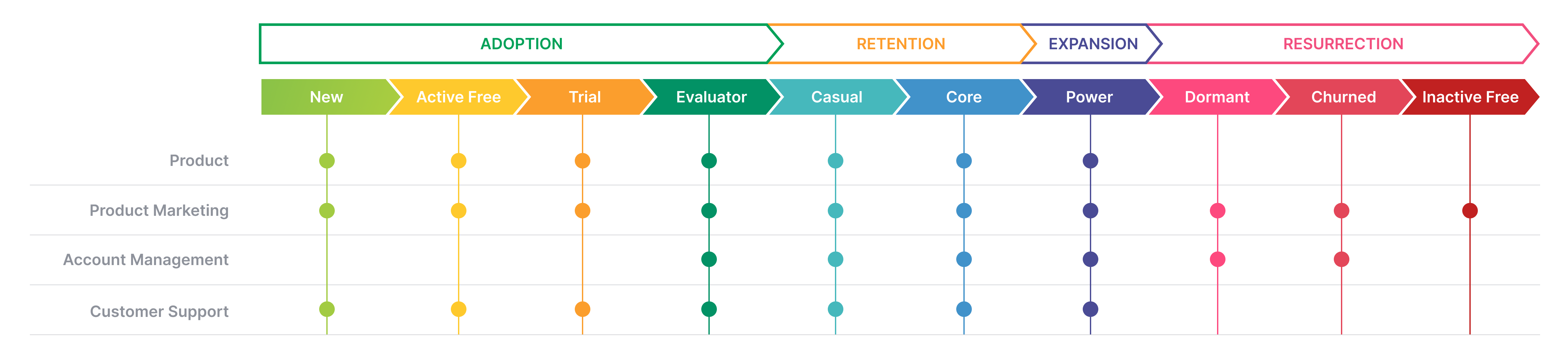
The real strength of the CLF is that it gives multiple teams a shared model of the customer. It helps everyone understand where an account is, what matters now, and how each function contributes to moving the relationship forward.
Product
Product operates across the entire lifecycle.
The team shapes onboarding and core UX, improves activation paths, runs in-app campaigns, refines PQL and Customer scoring, personalizes user experiences, and drives experiments that improve conversion, adoption, and retention.
Product Marketing
Product Marketing helps move users through the lifecycle with targeted communication and education.
That includes lifecycle campaigns, product updates, feature launches, newsletters, blog content, and messaging that supports setup, adoption, and retention. Product Marketing also plays a key role in amplifying the work of other teams by making value more visible and easier to understand.
Account Management
Account Management plays a broad role across the paid customer journey, from evaluation to expansion to churn prevention.
This includes supporting trial and evaluation motions, helping customers navigate plan selection and advanced use cases, guiding onboarding during the first 90 days, improving adoption over time, managing renewals, identifying expansion opportunities, and working with at-risk accounts before they churn.
Bringing these motions together under one lifecycle lens matters. Customers do not experience the company in departmental slices. They experience one journey. The more connected the ownership model is, the more coherent and effective that journey becomes.
Customer Success
Customer Success supports customers across the lifecycle by combining responsiveness, problem-solving, and insight gathering.
This includes answering questions quickly, troubleshooting issues, escalating technical problems, collecting feedback, identifying friction, supporting high-priority accounts, and surfacing product or UX improvements back to the rest of the organization.
This function is especially important because it often sees the truth first. It sees where users are confused, where activation breaks down, where feature value is not obvious, and where customer expectations do not match the product experience.
When all of these teams operate from the same lifecycle model, the business gets sharper. Priorities become clearer. Handoffs improve. Decisions become more contextual. The customer experience becomes more consistent.
That is the real payoff of alignment.
Why this matters
The Customer Lifecycle Framework matters because it turns customer centricity into something operational.
It gives us a structured way to understand where customers are, what they need, what signals matter, and how we should respond. It helps us move beyond intuition and build a shared system for making better decisions on behalf of the customer.
That has implications far beyond communication or segmentation.
It affects where Product invests.
It affects how Marketing educates.
It affects how customer-facing teams prioritize time.
It affects how we think about growth, retention, and expansion as one connected system rather than separate functions.
For me, that is the bigger lesson.
Strong product leadership is not just about building features or shipping fast.
It is about building systems that help the company understand customers better and act with more consistency across the entire journey.
That is what the CLF gives us at Databox.
Not a perfect model. Not a finished system.
But a much better way to align teams around the work that matters most: helping customers realize value and keep realizing more of it over time.